Today, I have the pleasure of dishing it up with John Blackport, author of Raingun and Resolution.
JET: Can you tell us about your most recent book?
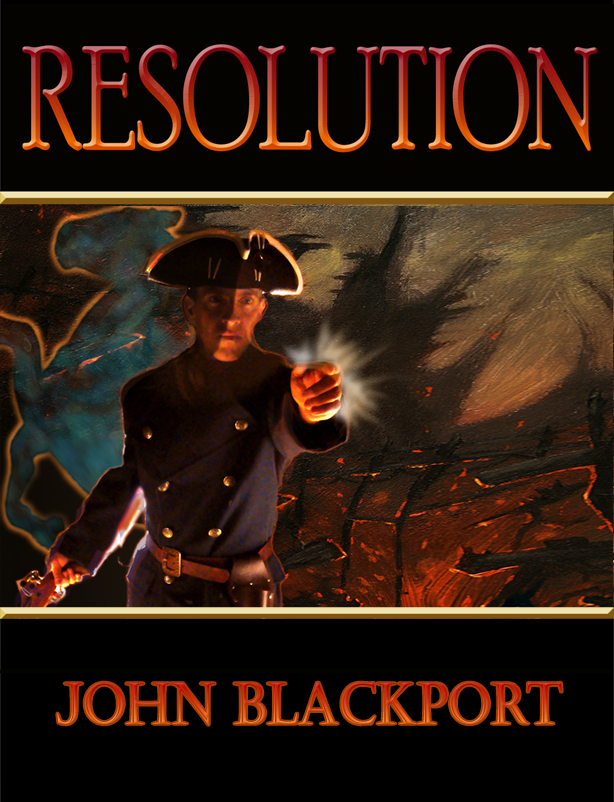
John: Resolution is the sequel to Raingun. In it, Rick directly confronts his temptation to rebel against the established order. He still feels the same internal conflict, but the stakes in the world around him are rising fast.
Rick’s guarding a mining camp full of slaves, and he sees a lot of cruelty. But the same army that is the instrument of the slaves’ oppression, is also protecting the people from other (very real) threats. The decision to start (or join) a rebellion isn’t easy, and anyone who decides to do it will find themselves neck-deep in many other decisions that must be made. And all these decisions are difficult.
JET: What’s been your most challenging hurdle on the road to publication?
John: Editing. I love the process, it’s just hard to find time to do it.
JET: What was your favorite moment in the journey?
John: I love the second half of the editing --- when the checked part of the checklist is bigger than the unchecked part. It all starts to come together, like a sculpture that finally looks like its subject. At that point, you can experience the same satisfaction building a novel that you’d get from building a house.
JET: Which authors had the most influence over you growing up?
John: Hmm. James Thurber. Edgar Allan Poe. Mark Twain. George Orwell. John Le Carre.
JET: When did you know you wanted to take the plunge into the writing world?
John: Oh, I’ve wanted that forever.
JET: What’s the craziest thing you’ve done in the name of book research? Most interesting fact you uncovered?
John: Sometimes I drive to specific spots, that remind me of the perfect setting for specific scenes I’m writing, and just hang out there, trying to make the setting a part of me. The farthest I’ve ever gone for that was an hour and a half from my home.
JET: Of all the novels and stories you’ve written - which one is your favorite? Why?
John: My favorite might be The Drillerist. I’ve always been impressed by the dedication of ancient and medieval surgeons. Those that understood the scientific method understood just how much there was to learn, and how slow their progress was. They understood they didn’t have a chance of seeing their efforts bear fruit in their lifetimes. And they understood just how pervasive the superstition was that they were up against.
JET: Any advice for the novices out there?
John: Don’t misinterpret advice to “Never give up”. Sometimes, you should give up on a specific endeavor. I did it a few times. I always came back to writing, but I often gave up on short-term goals and projects. The point is to shift your efforts into something more rewarding, or more productive.
JET: All right - now that I’ve hammered you with the big questions, let’s tackle my favorite (and geeky) quick ten…starting with…Paper or Plastic?
John: Paper! The rise of e-books will reduce overall paper production and reduce the environmental impact of that entire industry.
JET: Steak or Tofu?
John: What, no Port?! I mean, Pork?! (Actually, pork and port would be good). Um, Tofu!
JET: Beach or Mountains?
John: Beach! The food is better!
JET: Country or Rock-n-Roll?
John: Bhangra! Oh, that’s not a choice. Rock-n-Roll, I guess. It’s close.
JET: Top 10 best seller or Unknown Back Shelf Find?
John: I’m gonna go against the “indie” grain and say Top 10 Best Seller. Though I sort of sense that changing about myself.
JET: Zombies or Demons?
John: Zombies.
JET: Paper or Digital?
John: Digital.
JET: Silent Film Classics or Cheesy B Rated Horror?
John: Cheesy B Rated Horror!
JET: Sword wielding ninja or Gun toting momma?
John: Gun-totin’ momma!
JET: Coffee or Tea?
John: Coffee. Straight! Black! No sugar, no milk, no nothin’ wheeeeeeeeeeeeeeeee
JET: Thank you for indulging me. Before we wrap this up, can you tell us what you're working on now? What's next?
John: I’m starting the editing on the third book of The Raingun Chronicles. The title’s Balislanka, which is the name of a place. Rick moves against Lucan, a powerful necromancer, in a decisive confrontation. He wants this over with, to concentrate fully on what he truly wants to do: clean up the injustice and corruption in the country he loves.
JET: Thank you so much for taking the time to chat on my blog. Folks, you can find out more about John Blackport’s books on his Amazon Page.
Until Next time,
Ciao
JET
Showing posts with label Raingun. Show all posts
Friday, February 24, 2012
Wednesday, November 16, 2011
Guest Spotlight with John Blackport
Welcome to a special Wednesday Guest Blog. I’ve got John Blackport on tap today. John has been writing the Raingun stories for many years and is the ultimate non-pantser. He lives in New England with his family and several imaginary cats. He owns a tricorner hat --- he doesn't wear it very often, but by all accounts it looks great on him!
The Amazon sample can be read without a download here on Kindleboards: http://www.kindleboards.com/sample/?asin=B005HQ4JAO
Since men read as much as women do, but read a lot less fiction, some writers worry about whether they can entice male readers. From there, the question becomes: how can it be done?
Surprisingly, the answer isn’t directly related to sex. . . at least not in the way many people expect. In my experience, male readers like explicit sex in novels far LESS than theire female counterparts. I’ve heard a few theories about this from women, mostly not very flattering to men: something about us being so obsessed with visual stimulation, particularly porn, that we’re uncomfortable with anything sexual that requires imagination, or is less than 100% visual.
Some of the most vocal male supporters of "fade to black" pointed out examples where it was "done right". They showed me excerpts from some "boy books" where the hero bangs lots of women, who are rarely seen naked and never seen having sex --- they mostly lounge around in bathrobes and towels with their hair messed up. They hang all over the hero’s shoulders and compliment his technique.
This leads to another theory about why women seem to enjoy explicit sex scenes more: men don’t want to have sex vicariously through a hero. The vicarious experience they do want is the experience of being sexually irresistible. They want to read about the heroine internally drooling when she steals a glance at the hero’s physique.
Of course, you could say that the terms of “male reader” and “female reader” are also oversimplifications --- a person’s reading preferences probably has more to do with their sexual attitudes than their sexual equipment --- but we all have to start somewhere, so here is my own theory:
Men prefer external obstacles to internal ones.
The male perception of why “women’s entertainment is so dull” --- admittedly, not always a fair one --- springs from the worry that the struggle will always come down to a heroine trying to come to a decision, or work up the courage to do something. Men don’t mind this stuff merely existing in a novel, but they tire of it easily, and if they don’t see something more tangible going on, they’ll roll their eyes and dismiss the story’s conflict as endless dithering.
The most obvious way around this is a hostile enemy (or rival) who must be defeated or thwarted, whose moves must be met with countermoves. Taken to extremes, this results in stereotypical “men’s entertainment”, full of explosions, car chases, and women who are passive and clueless.
What intrigues me most about this prospect is that it explains why I know so many men who are closet fans of paranormal romance. There are more of them than you’d think, and I think they’re drawn to the ass-kicking heroines. They’re pickier than the female fans of the genre seem to be --- but the strongest common thread between their preferences seem to be a heroine who is active, not passive. Men have a lot more tolerance for passive heroines in a story where the hero is the main character, but it’s still not their “top pick”. And in the case of a female main character, their preference for active heroines is overwhelming. In my experience, the men who won’t read stories with a female protagonist largely do so from a preconceived notion that she will be too passive to be interesting.
In the absence of an enemy, men still want the protagonist to face obstacles with physical, objective manifestations. In the case of a man who wants a woman, this could take many forms: “I can’t have her until I mend the rift between our families,” “I have to smuggle her out of this war zone,” or “I have to find the cure to this disease before it kills her.”
If a conflict is internal --- existing entirely in characters’ minds and hearts --- men still want to see it as the accomplishment of a goal. So when the hero disappoints the heroine, most male readers don’t want to see the heroine agonize about whether or not to forgive him. They’ll dismiss such a heroine as an airhead. In such a case, they want to see the heroine be mad, so that all is lost unless the hero actively changes it. They want to see the hero struggle to earn her forgiveness by making it up to her --- and not with sweet talk and empty promises, either! With deeds. Even if the roles are reversed, and the heroine is the one who has disappointed the hero, they want to see the road to reconciliation to be an active attempt at redemption, not passive waiting.
Men don’t respect a hero who waits to see how things shake out --- and heroines who do so don’t fare much better. If the hero is forced into passivity, he should show he’s forced into it: ideally, by trying an active plan which fails, and he must be visibly enraged at its failure.
Of course, the best novels contain conflicts that have both internal and external components. How these perceptions are best acted upon is a question of narrative manner --- how you emphasize what’s going on. Some authors like to have the hero and the heroine sharing the spotlight --- this used to mean mixing internal and external conflicts throughout the book. Now, it means mixing internal and external conflicts through both the hero and the heroine, as individuals. It’s tricky but it’s worth it.
Thanks for swinging in!
Until next time,
Ciao.
JET
The Amazon sample can be read without a download here on Kindleboards: http://www.kindleboards.com/sample/?asin=B005HQ4JAO
WHAT MALE READERS WANT by John Blackport
Since men read as much as women do, but read a lot less fiction, some writers worry about whether they can entice male readers. From there, the question becomes: how can it be done?
Surprisingly, the answer isn’t directly related to sex. . . at least not in the way many people expect. In my experience, male readers like explicit sex in novels far LESS than theire female counterparts. I’ve heard a few theories about this from women, mostly not very flattering to men: something about us being so obsessed with visual stimulation, particularly porn, that we’re uncomfortable with anything sexual that requires imagination, or is less than 100% visual.
Some of the most vocal male supporters of "fade to black" pointed out examples where it was "done right". They showed me excerpts from some "boy books" where the hero bangs lots of women, who are rarely seen naked and never seen having sex --- they mostly lounge around in bathrobes and towels with their hair messed up. They hang all over the hero’s shoulders and compliment his technique.
This leads to another theory about why women seem to enjoy explicit sex scenes more: men don’t want to have sex vicariously through a hero. The vicarious experience they do want is the experience of being sexually irresistible. They want to read about the heroine internally drooling when she steals a glance at the hero’s physique.
Of course, you could say that the terms of “male reader” and “female reader” are also oversimplifications --- a person’s reading preferences probably has more to do with their sexual attitudes than their sexual equipment --- but we all have to start somewhere, so here is my own theory:
Men prefer external obstacles to internal ones.
The male perception of why “women’s entertainment is so dull” --- admittedly, not always a fair one --- springs from the worry that the struggle will always come down to a heroine trying to come to a decision, or work up the courage to do something. Men don’t mind this stuff merely existing in a novel, but they tire of it easily, and if they don’t see something more tangible going on, they’ll roll their eyes and dismiss the story’s conflict as endless dithering.
The most obvious way around this is a hostile enemy (or rival) who must be defeated or thwarted, whose moves must be met with countermoves. Taken to extremes, this results in stereotypical “men’s entertainment”, full of explosions, car chases, and women who are passive and clueless.
What intrigues me most about this prospect is that it explains why I know so many men who are closet fans of paranormal romance. There are more of them than you’d think, and I think they’re drawn to the ass-kicking heroines. They’re pickier than the female fans of the genre seem to be --- but the strongest common thread between their preferences seem to be a heroine who is active, not passive. Men have a lot more tolerance for passive heroines in a story where the hero is the main character, but it’s still not their “top pick”. And in the case of a female main character, their preference for active heroines is overwhelming. In my experience, the men who won’t read stories with a female protagonist largely do so from a preconceived notion that she will be too passive to be interesting.
In the absence of an enemy, men still want the protagonist to face obstacles with physical, objective manifestations. In the case of a man who wants a woman, this could take many forms: “I can’t have her until I mend the rift between our families,” “I have to smuggle her out of this war zone,” or “I have to find the cure to this disease before it kills her.”
If a conflict is internal --- existing entirely in characters’ minds and hearts --- men still want to see it as the accomplishment of a goal. So when the hero disappoints the heroine, most male readers don’t want to see the heroine agonize about whether or not to forgive him. They’ll dismiss such a heroine as an airhead. In such a case, they want to see the heroine be mad, so that all is lost unless the hero actively changes it. They want to see the hero struggle to earn her forgiveness by making it up to her --- and not with sweet talk and empty promises, either! With deeds. Even if the roles are reversed, and the heroine is the one who has disappointed the hero, they want to see the road to reconciliation to be an active attempt at redemption, not passive waiting.
Men don’t respect a hero who waits to see how things shake out --- and heroines who do so don’t fare much better. If the hero is forced into passivity, he should show he’s forced into it: ideally, by trying an active plan which fails, and he must be visibly enraged at its failure.
Of course, the best novels contain conflicts that have both internal and external components. How these perceptions are best acted upon is a question of narrative manner --- how you emphasize what’s going on. Some authors like to have the hero and the heroine sharing the spotlight --- this used to mean mixing internal and external conflicts throughout the book. Now, it means mixing internal and external conflicts through both the hero and the heroine, as individuals. It’s tricky but it’s worth it.
Thanks for swinging in!
Until next time,
Ciao.
JET
Subscribe to:
Posts (Atom)